Fraud Prevention & Behavioral Analysis for Mobile Applications
Is your application ready to detect fraud in real-time?
Fraud in mobile applications has evolved significantly. Today, attackers not only compromise credentials but also simulate human behaviors, manipulate devices, and automate interactions to evade traditional controls.
At Just Mobile Security, we help companies evaluate and strengthen their fraud detection and prevention mechanisms in mobile applications (Android & iOS), analyzing both proprietary implementations and third-party integrations (SDKs).
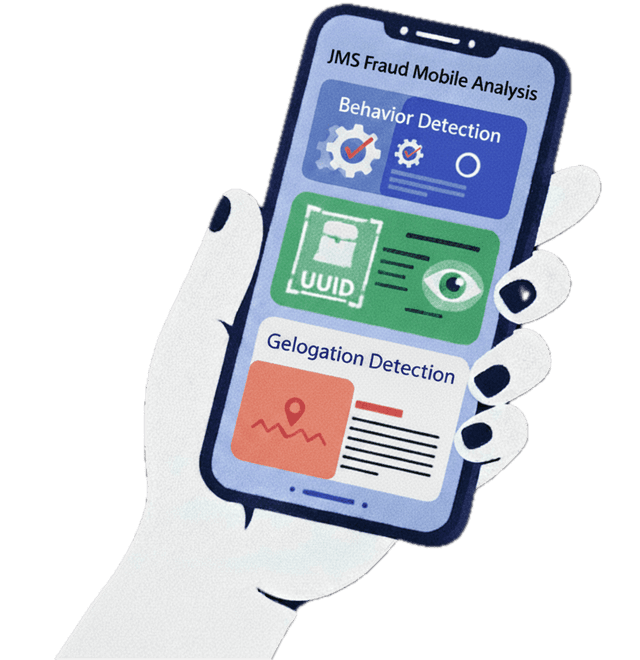
What do we analyze?
During our evaluations, we perform a static and dynamic analysis focused on identifying weaknesses in modern anti-fraud mechanisms, including:
Integrations with third-party anti-fraud platforms (SDKs)
- Analysis of third-party SDKs and APIs (BioCatch, NuData Security, ThreatMetrix, Featurespace, BehavioSec, TypingDNA, SecuredTouch, Zighra, UnifyID, AimBrain, Plurilock, Callsign, NeuroID, OneVisage, Sift, Riskified and more).
- Client-server communication validation.
- Response integrity evaluation (risk score manipulation).
- Hard-coded keys or credentials within the code.
Behavioral Biometrics
- Validation of implementations such as Keystroke Behavior (how they type: speed, latency), Navigation Behavior (how they navigate the app: times, paths), Cognitive Behavior (how they complete forms, decisions), Session Behavior (patterns within a session), Anomaly / Risk Behavior (detection of deviations vs baseline).
- Evaluation of resilience against automation or human behavior simulation.
- Device Interaction Behavior (sensors, orientation, device usage).
- and more!
Device Intelligence & Fingerprinting
- Evaluation of anti-emulation, anti-root/jailbreak mechanisms, etc.
- Analysis of device ID persistence and its resistance to evasion.
- Identification of device fingerprinting controls (SHIELD, FingerprintJS, etc.).
Session protection and authentication
- Evaluation of login and authentication flows.
- Detection of Account Takeover (ATO) vulnerabilities.
- Validation of step-up authentication controls (MFA, OTP, biometrics).
Automation and Bots
- Evaluation of protection against bots and automated scripts.
- Simulation of automated attacks (credential stuffing, abuse flows).
- Anomaly detection analysis.
How do we do it?
Thanks to our vulnerability detection tool for mobile applications TUNGSTENIC, we can quickly detect if an application implements any Anti-fraud SDK and how, and then complete the analysis with our cybersecurity experts to determine whether there are associated vulnerabilities or not.
In addition to all this, we implement validations based on standards such as:
- OWASP MASVS / MASTG.
- OWASP Top 10 (Mobile & Web).
- Testing from the attacker's perspective (black/grey-box).
Analysis stages
Static analysis
- Code review (reverse engineering).
- Identification of integrated anti-fraud SDKs.
- Evaluation of insecure configurations.
Dynamic analysis
- Instrumentation with tools (Frida, Xposed, LLDB, etc).
- Traffic interception (MITM).
- Manipulation of events and signals.
Fraud simulation
- Emulation of devices and controlled environments.
- Automation of interactions (bots).
- Bypass testing of anti-fraud controls.
- Identification of bypass in critical flows.
What do we deliver?
- Technical report.
- Executive report.
- Fraud exposure level.
- Business impact.
- Strategic recommendations.
Additional value
- 100% mobile focus (not generic).
- Experience in bypassing real anti-fraud SDKs.
- Combined evaluation: behavior + device + backend.
- Aligned with real attack scenarios.
- Daily updates on the service.
Key differential
While many providers only implement anti-fraud solutions, at Just Mobile Security we evaluate how effective they are against real attackers, with advanced attack simulation, to determine if it is possible to breach these protection mechanisms and identify their implementation at the code level.