RASP & Custom Mobile App Protection Analysis
Do your protection mechanisms really withstand an attacker?
Modern mobile applications implement protection solutions such as RASP (Runtime Application Self-Protection), anti-tampering, anti-hooking, and anti-emulation to make reverse engineering and application manipulation more difficult.
However, an incorrect implementation or a false sense of security can allow an attacker to continue performing instrumentation, control bypass, and attack automation.
At Just Mobile Security we help companies assess the effectiveness of their protection mechanisms in Android and iOS applications, analyzing both in-house implementations and third-party solutions using TUNGSTENIC.
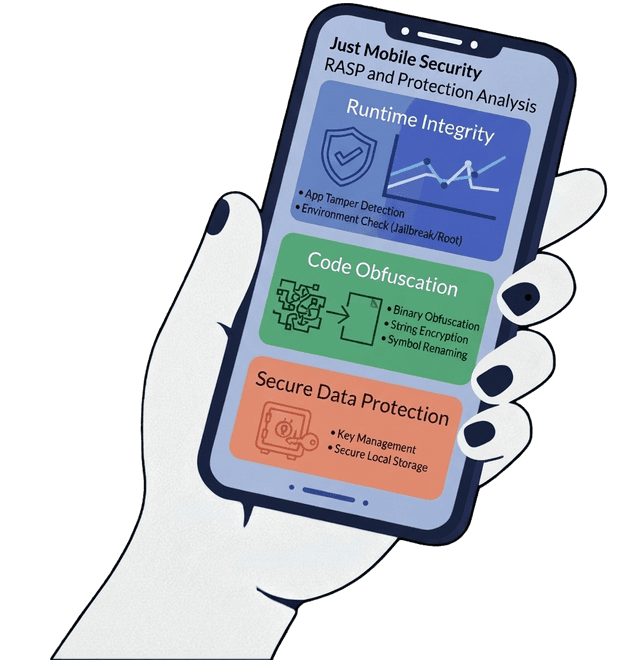
What do we analyze?
During our assessments, we perform static and dynamic analysis focused on identifying weaknesses in modern protection mechanisms.
Integrations with protection platforms (SDKs)
- Insecure configurations.
- Protection of secrets and credentials.
- Hard-coded keys.
- Integrity validation.
- Bypass resistance.
- Client-side only validations.
- Protection of APIs and sessions.
Runtime Application Self Protection (RASP)
- Root Detection.
- Jailbreak Detection.
- Emulator Detection.
- Virtual Environment Detection.
- Frida Detection.
- Xposed Detection.
- Magisk Detection.
- Hooking Detection.
- Debugger Detection.
- Dynamic Instrumentation Detection.
- Runtime Integrity Verification.
Anti-Tampering and Binary Protection
- APK/IPA signing and integrity.
- Protection against repackaging.
- Checksum validation.
- Anti-modification.
- Protection against patching.
- Protection against resigning.
- Anti-cloning.
Anti-Reversing
- Obfuscation.
- String Encryption.
- Control Flow Obfuscation.
- Class Encryption.
- Resource Encryption.
- Native Protections.
- Anti-static analysis.
- Anti-disassembly.
Protection against Instrumentation
- Frida.
- Objection.
- Xposed.
- Magisk.
- LLDB.
- GDB.
- Cycript.
- Dynamic Libraries Injection.
- Runtime Hooking.
Device Integrity & Environment Validation
- Root / Jailbreak.
- Emulation.
- Virtualization.
- Device Cloning.
- Device Fingerprinting.
- Custom ROMs.
- Magisk Modules.
- Hidden Root Techniques.
How do we do it?
Thanks to our development for vulnerability detection in mobile applications, TUNGSTENIC, we can quickly identify protection technologies implemented within an application and determine how they were configured, subsequently allowing our specialists to analyze their effectiveness against real-world scenarios.
Additionally, we implement validations based on:
- OWASP MASVS / MASTG.
- OWASP Top 10.
- Testing from the attacker's perspective (black-box and grey-box).
Analysis stages
- Static analysis.
- Dynamic analysis.
- Bypass simulation.
What do we deliver?
- Technical Report.
- Executive Report.
- Exposure level of protection mechanisms.
- Business impact.
- Strategic recommendations.
- Findings prioritization.
Added value
- 100% mobile-focused approach.
- Hands-on experience bypassing commercial protection solutions.
- Assessment from the attacker's perspective.
- Simulation of real-world scenarios.
- Ongoing research into new bypass techniques.
- Continuous service updates.
Key Differentiator
While many providers implement protection mechanisms or sell App Shielding solutions, at Just Mobile Security we assess how effective they are against real attackers, simulating advanced instrumentation, hooking, manipulation, and bypass techniques to determine whether it is possible to compromise the implemented protections and reduce the risk of reverse engineering and fraud.